 For manufacturers
 For specialist retailers
 Planners & architects
 Product centre/BECKERinside

Electric standing aid makes it easier for people with disabilities to stand up
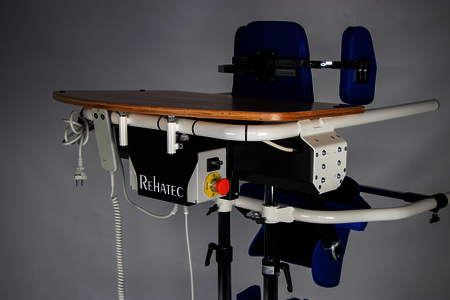
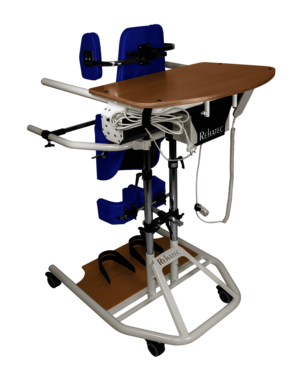
Many people are familiar with the feeling that getting up can sometimes be difficult. But very few people know what it means to be unable to sit up and stand upright unaided due to a physical and/or mental disability. For such children, young people and adults, the company Rehatec, based in Baden-Württemberg, develops high-quality, practical aids with significant therapeutic benefits that also promote active participation in life and social interaction within our society. For example, the Heidelberg-based ‘Impuls’ standing aid safely and comfortably moves patients from a sitting to a standing position and back again. A special feature of this standing aid is its electric strap retraction system, which allows an anatomically shaped seat belt to be rolled up and down at the touch of a button. This significantly reduces the burden on carers, as they can effortlessly help even heavy patients to stand up. And the patients themselves also benefit: from greater safety and comfort – two factors that played a decisive role even when selecting the drive system. The product developers at Rehatec eventually found what they were looking for at Becker-Antriebe, the Hessian specialist in drive systems and controls for roller shutters, sun protection and specialised applications.
Direct current drive for maximum safety
What makes the Becker drive – which is normally used to automate roller shutters – so special is that, unlike comparable drives on the market, it runs on direct current, which further enhances safety when using the standing aid. “With our assistive devices, we bear a great responsibility for the well-being of our customers. It was therefore crucial for us to determine how we could achieve maximum performance with maximum safety in our electric standing aid,” explains Melanie Feuerstein, Head of Marketing at Rehatec. “For proper operation, our ‘Impuls’ standing aid must be connected to the mains supply. Although the risk of electric shock is extremely low, But even in this unlikely event, we wanted to rule out any risk to patients and their carers. That is why we decided to avoid AC drives, as are usually offered. Whilst searching for a solution, we came across Becker, who also manufacture DC drives. These combine powerful performance with low current – exactly what we needed.” Working closely with Rehatec, we then turned our attention to the details. This is because the experts at Becker place particular emphasis on one thing when advising clients: understanding exactly what makes their customers’ solutions unique. On this basis, the ideal drive type was ultimately identified for Rehatec and tailored specifically to their requirements.
Unwinds and winds up straps slowly and quietly
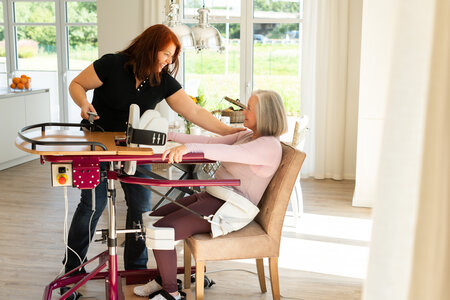
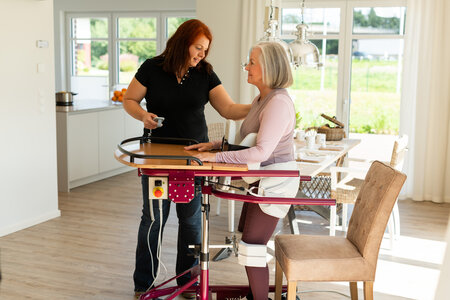
The process of standing up in the Impuls standing frame is usually carried out from a wheelchair. The people using it are usually hypertonic due to their condition and exhibit significantly increased muscle tone. Alternatively, they may be hypotonic, which is associated with low muscle tone and consequently a rather slumped posture. In both cases, patients are unable, or only barely able, to move from a sitting to a standing position unaided. This makes it all the more important that the standing-up process in the Heidelberg Impuls standing frame is carried out as gently as possible. Here, too, the Becker drive system proves invaluable: it runs particularly slowly and quietly, ensuring maximum comfort for both patients and carers. To assist the patient in standing up, a seat belt is positioned correctly in the wheelchair and securely fastened to the patient’s pelvis using Velcro. The seat belt is connected via snap hooks to the electric belt rewind mechanism, which can be activated via a hand-held switch to wind the belt up and down. As soon as the patient has reached an upright position, the belt rewind mechanism – and thus the standing-up process – stops automatically. To this end, the standing aid is fitted with a padded chest pad which, upon contact, immediately triggers the motor’s emergency stop mechanism. The retraction function of the hand-held switch is also automatically blocked by the emergency stop buffer. This means that once the motor has stopped, the belt can only be unwound using the hand-operated switch, so that the patient can be lowered safely and comfortably back into a seated position at the end of the standing exercise.
Safe steering in every situation
In addition to the emergency stop, the compact control unit for the electric strap rewind mechanism features further safety-related functions that ensure the standing aid can be used with peace of mind. For instance, the drive can be stopped at any time if necessary using an easily accessible emergency stop button. In the event of a power cut, it is also possible to wind the strap back manually using a key provided. “We are delighted to have had Becker as a strong partner at our side since 2021,” emphasises Melanie Feuerstein of Rehatec. “From the high-quality build to the first-class service, everything is just right, and our customers are also delighted with the new model of our standing aid. This is particularly important to us, as it is they who, in practice, must be able to rely 100 per cent on the technology being used.” In the best sense of the word, Becker therefore remains true to its brand promise here: to make things easier for everyone.
Detailed information on the Heidelberg Impuls standing aid can be found at: www.rehatec.com
Watch the YouTube video to see the electric standing aid in action